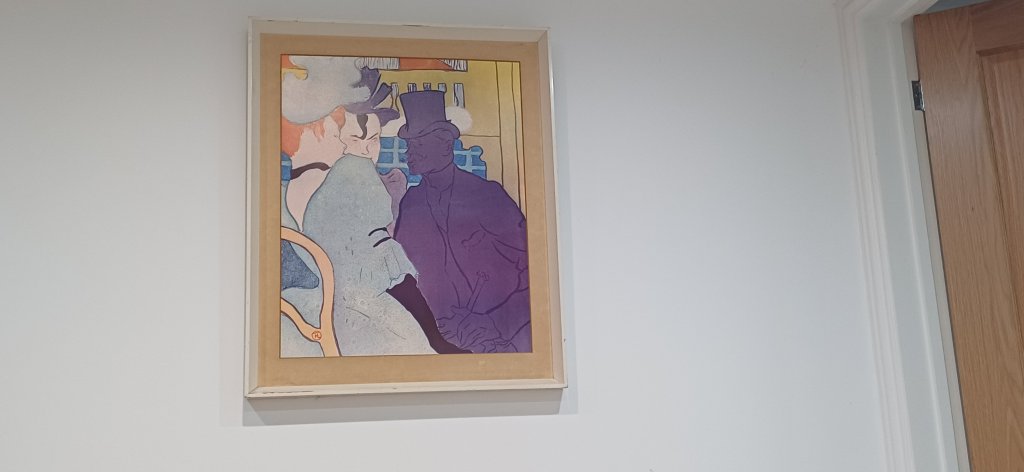
At first glance, Henri de Toulouse-Lautrec’s iconic lithograph might seem like a typical Parisian scene, stylish, nostalgic, and full of character. This picture, a huge 1970s vintage retro copy, has pride of place in my bedroom. It’s funny, I live the picture but never really interpreted it. After a few years in place, it occurred to me. This guys a bit creepy.
The seated woman in pale blues and greys, elegantly dressed with her hat perched just so, draws you in and the obsequiousness of the gentleman deflects. It’s a familiar depiction of 1890s Montmartre nightlife, with its cabarets and cigarette smoke, echoing with laughter and merriment.

But there’s something unsettling, almost sinister, about the man seated next to her. He’s not just another finely dressed patron. Depicted entirely in a deep, shadowy purple, the man’s features are obscured, his form dominating the right half of the image like a creepy silhouette. He has no face, except close up, no light, and no invitation. Just a malevolent presence, heavy, imposing, and silent.
From Romance to Recoil
Initially, the image may read as a romantic moment. The man leans in slightly, perhaps whispering something to the woman beside him. She turns her face partly toward him, their proximity suggesting conversation or flirtation. But then the body language becomes unravels.
Look again.
The woman is not leaning in — she’s leaning away. Her posture is subtly recoiled, her shoulder tilted back, as if trying to create distance. Her eye, half-visible, seems disengaged. Is she uninterested? Uncomfortable? She looks threatened.
The purple figure, once possibly interpreted as a suave companion, becomes a menace. His shadowy form encroaches, emotionally and physically. His very facelessness removes individuality, reducing him to a kind of looming archetype, almost a visible poltergeist— a man not of romance, but of control, perhaps even threat.
Purple as Power and Omission
Purple has long symbolized power, wealth, and mystery. But in this context, it carries an unsettling weight, authority, without warmth, presence without intimacy. It’s as if he’s not part of the conversation, but part of the woman’s burden.
Loneliness, Gender, and Urban Nightlife
Much of Toulouse-Lautrec’s work chronicled the backstage truths of Parisian nightlife, its performers, sex workers, and working women. While often romanticized in retrospect, his paintings and prints are deeply layered with ambivalence. His women are rarely passive or objectified without comment; instead, they are often depicted as isolated, self-possessed, or subtly defiant.
In this context, the woman’s backward lean isn’t just body language, it’s resistance. She is emotionally distant, aware of the gaze upon her, yet unmoved by it. The purple figure could be a customer, a stranger, or a regular, but he remains unknowable, and that’s the point. A paradox, the visceral nature of the painting.
The Haunting Afterglow
What begins as a charming period piece ends as something more chilling. The atmosphere turns from warm nostalgia to quiet discomfort. The shadow in the room isn’t just a figure, it represents a feeling. Once you see the menace, you can’t unsee it. The purple man stays with you, long after you’ve looked away.
And that’s the genius of Toulouse-Lautrec. He paints more than people — he paints dynamics, tensions, and the truths that linger in silence.
Yup. I will be removing it away from the prime position as it unsettles me now.
Fortuitously, I have a wonderful original oil painting of Montmartre by Hervalganthe and this will be a suitable replacement.


 The Rights of Fans.