BY Chris Harris
There is a link to 5 other blogs I have written about The Clash at the bottom of the blog.
When you think of The Clash, you probably picture The Clash, Give ’em Enough Rope, London Calling, Sandinista! and Combat Rock, albums that turned righteous anger into transcendent art. You don’t usually think of Cut the Crap. Yet, in the decades since its release, this much maligned record has developed an odd cult following. Some insist that if you strip away the expectations, you’ll find a raw, flawed album that deserves another listen. I’m one, of course it is their worst album, but take away the artist and listed to the songs, I think it is pretty good.
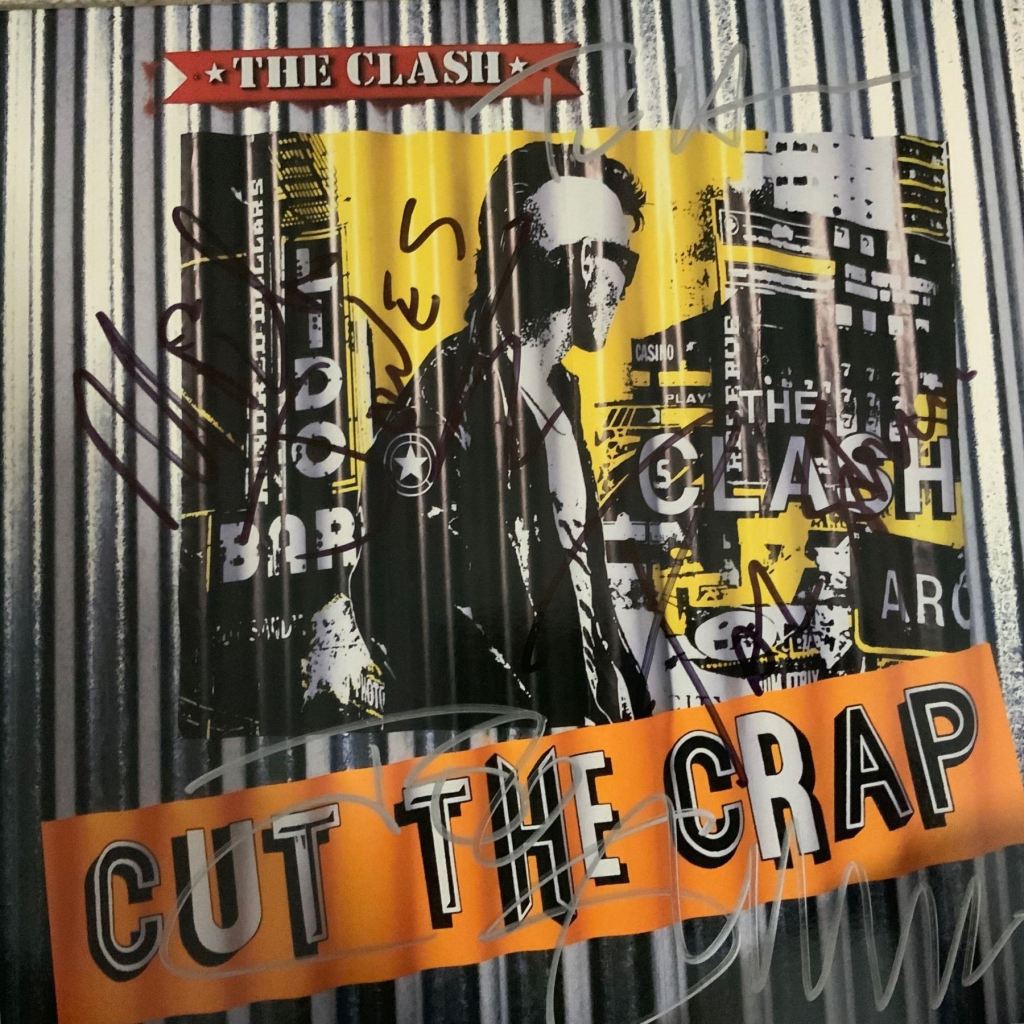
Cut the Crap was released on November 4, 1985, by CBS Records, clocking in at just over 46 minutes. It was produced mainly by Bernard Rhodes, The Clash’s longtime manager, with a nominal co-credit to Joe Strummer. But by that point, of course, the band was little more than a hollowed out brand. The classic lineup was gone. Mick Jones and Topper Headon had departed, leaving Strummer and bassist Paul Simonon to front a new group of recruits: guitarists Nick Sheppard and Vince White and drummer Pete Howard, though most of Howard’s live drumming was replaced by programmed machines. In the studio, Rhodes took charge, determined to make a Clash record that sounded contemporary, even if it meant suffocating the music under layers of synthetic production.
Joe Strummer himself was never shy about how he felt. He called the album “a mess” and referred to it as “the last blunder of The Clash.” He regretted letting Rhodes dominate the sessions and later said it probably should never have been released. Over time, he distanced himself almost entirely, rarely playing its songs live or acknowledging it in interviews. He seemed to feel that Cut the Crap was an obligation more than an inspiration, a way to keep the name alive in the hope something better might follow, maybe time might heal the rifts and addictions of Jones and Headon.
Despite this, some critics and fans have argued that the record isn’t a total disaster, just a casualty of impossible expectations. Strummer’s vocals are as ferocious and committed as ever, capturing his anger about Thatcher-era Britain with raw conviction. in many ways it felt more urban and grounded than Combat Rock. The heavy use of sequencers, drum machines, and shout-along choruses, so often derided at the time, would later turn up in the DNA of late ‘80s and early ‘90s alternative rock. If you can set aside the fact that it was supposed to be The Clash, some tracks reveal a bruised energy that feels more like a solo outburst than a band statement. “This Is England,” in particular, stands out as a genuinely powerful song, and remains the only track from the album that most fans and Strummer himself seemed willing to embrace.
Uncut Magazine once described the album as “a deranged, fascinating wreck,” which feels about right. Even so, I agree, the consensus remains that Cut the Crap is the weakest entry in The Clash catalogue because it lacks the adventurous spark that made the band a legend. Like McCartney and Lennon after The Beatles, Strummer and Jones spent their solo years releasing interesting music that never quite recaptured the magic they shared together. Their work apart often felt like an after main event, never bad exactly, but somehow diminished without the alchemy of collaboration.
In the end, Joe Strummer was dismissive of Cut the Crap for good reason. It was an album born of desperation and conflict, a product of too many compromises and too little inspiration. But if you can let go of the myth of The Clash, you may discover an artifact with its own stubborn vitality. It’s the sound of a legend trying to keep the fire alive as everything fell apart. And in its own imperfect way, that’s worth hearing, it is surely an integral cog in the history of the Clash, that maybe need not be loved but be acknowledged as the album that showed Strummer, Jones , Simonon and Headon were the real deal, up there with the best ever. Cut the Crap, maybe a good warm up act.
#The Clash #Cut The Crap #Pink History #Joe Strummer #Punk Rock

 The Rights of Fans.