If you’ve been in the vintage or antique trade long enough, you know the score. That growing mountain of unfinished projects, job lot leftovers , yes all with “potential” and none with urgency. They are all worth money, but will you ever realise the money?
Like many of us dealers, I work from a big warehouse and a fully equipped workshop. I buy at auction, often in job lots, and the logic is solid: most dealers don’t want mixed bundles, so you pay less per item for job lots, supply and demand. That’s the theory, and often, it works beautifully.
But there’s always a catch: you end up with loads of things you never actually use. They are all worth good money, but a lot of work too, and somehow you never get out of the regular buy and sell routine and find the time to realise the value through restoration.
You tell yourself they’re valuable. You imagine fixing them up, listing them, selling them for a tidy profit. You mean to. You even believe you will. Just not today.
They longer, like an unshakeable illness at the back if the warehouse, gloating at you in the safety of your inertia to deal with them.
For me, it reached a ridiculous point: a full third of my 3,000-square-foot warehouse was filled with “projects”. That’s easily £50,000 to £60,000 worth of stock… in theory. All it needed was time, effort and restoration.
It turns out this isn’t just a quirk of antique dealers. It’s standard thinking anywhere, the emotional tendency to hang onto something just because you’ve already invested time or money in it. Even if it’s no longer serving you.
But there’s also another layer to it. Neuroscientists point to a phenomenon called “decision fatigue.” I know great name! When we’re surrounded by unfinished decisions,fix it, bin it, list it, move it, our brain starts to shut down. We become paralysed. With every new project added to the pile, the sense of overwhelm increases and we simply become accepting of our irrationality.
It literally becomes emotionally draining, even if you’re not doing anything with the stuff. Simply seeing it every day takes a toll.
This is made worse by the dopamine loop we get from acquiring, especially bargain hunting. Buying gives us a little rush of excitement, a hit of novelty. It’s a reward. But finishing? That’s work. Harder. Slower. Less sexy. That’s why we keep buying, even when we’re buried under old stock. It’s why so many restorers end up overwhelmed, cluttered, and stuck.
The Breaking Point And the Breakthrough
After 40 years in the business, I hit a wall. I was sick of navigating around stacks of dusty frames and forgotten chairs. Sick of pretending I’d get around to them. Wondering when I’d trip over some of it and seriously injure myself, oh the irony!
So I did something radical: I started giving it all away.
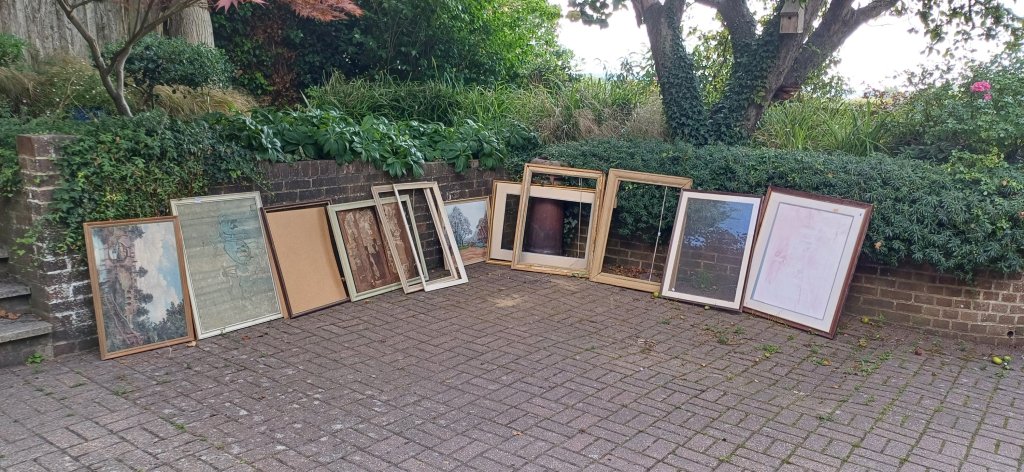
I listed frame bundles on Facebook Marketplace and Freecycle. I called up mates in the trade. I gave them away with zero guilt and no second thoughts. I advertised bundles of furniture for restoration, all free. Some of these items had followed me from unit to unit for a decade. Letting go didn’t feel like a failure. It felt like freedom. Cathartic.
It wasn’t just about clearing space. It was about clearing mental space. Each item I gave away lifted something invisible from my shoulders. That energy was instantly redirected to what actually matters, to things I could sell, restore, photograph, enjoy. It felt surprisingly great knowing someone else will take these items, transform them, and make money from them. I’ve paid my dues. Let someone else enjoy the upside now.
We always think of value in terms of stock. But space has value too, as corny as it sounds. That empty third of my warehouse will soon be stocked with mirrors, cabinets, and tables, making me money and I’ll be able to give up an auxiliary container costing me £2,500 a year.
The Benefit Of A Leap of Faith
Letting go forced me to reframe how I work. This wasn’t about quitting. It was about reclaiming clarity. Decluttering the warehouse decluttered my mind. For the first time in years, I walk into my space and feel calm. You don’t walk in and see a massive collection of vintage items that will take three back breaking months to work through, as I restock the area I will soon be walking in and seeing the rotation of fresh completed goods coming in and product leaving to go to people’s homes and money going into my bank account.
So no, I haven’t lost £50,000. I’ve gained clarity. I’ve gained focus, I’ve gained space to grow my business and enjoy my work again and most important, the anchor of all business, large and small, efficiency.
#VintageBusiness #DeclutterToGrow #RestorationLife #AntiqueDealerTruths #LetGoAndThrive

 The Rights of Fans.