
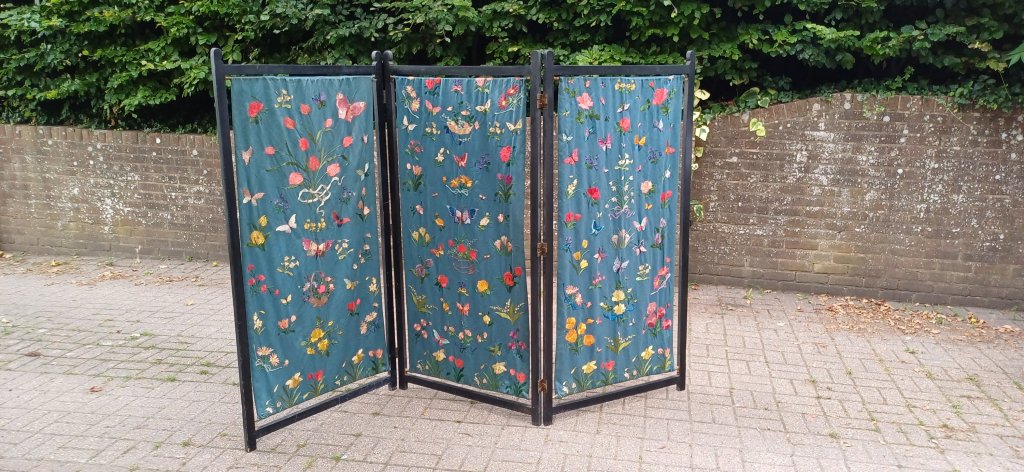
It sounds simple, doesn’t it? “Just be patient.” Yet in practice, it’s the hardest advice to follow, especially in restoration, where things often don’t go to plan. Take this past Saturday. I’d just bought a beautiful Victorian three-fold wooden screen with embroidered panels. “It’s been in my garage a long time,” the seller said, no not really. Sure enough, it was dusty, but nothing a quick clean wouldn’t fix.
That’s what I should have done. Ten minutes with soapy water. But instead, I decided to unscrew the rails and run the fabric through the machine, faster and more thorough, I thought. It was not. Of course, every screw was rigidly fixed in place, with thin heads and stubborn threads. Removing them became an ordeal. Still, I don’t beat myself up for that. It did seem like the quicker, better option.
That’s just bad luck and judgement, we all do that everyday, it is unavoidable,
Where it really went wrong and logic evaporated was the reassembly.
The six brass rods that held the panels together were an absolute nightmare to thread back through. The fabric bunched up at the ends, making each threading a struggle. Worse, the material had shrunk slightly during washing, so refitting everything became an exercise in brute force. The more I forced it, the tighter everything felt, and the more I ignored my instincts telling me to just stop.
At that point, it wasn’t about logic. It was pure obstinacy. I could feel it, this low boil of frustration growing with every stubborn screw and misaligned bracket. Tick tock, loke clockwork it grew with my tempered fury. I knew it was going wrong. I knew that if I walked away and tried again tomorrow, I’d have it sorted in two minutes. But that’s the cruel trick of the mind. When you’re in that state, you want it done. Not well, not cleverly, just done.
Eventually, predictably, I cracked the edge of one joint and if began to disintegrate. I had to re-glue and clamp it and generally make good, the final top corner repair alone cost me over an hour and an endless amount of swearing. The worst part? What got me wasn’t the break, or the clamp, or the wasted hour. What really wound me up was that I knew, I absolutely knew, I should have stopped.
The next day, with fresh eyes, I saw the obvious solution in seconds. I loosened the bottom row of screws to give the top row some give, and everything aligned perfectly. Job done in two minutes. I’d wasted in all, two hours battling a problem that didn’t need to exist.
So why do we do this? Why, despite years of experience, do we ignore the voice telling us to walk away?
The Medical and Psychological Reason Patience Fails Us. The Science.
This isn’t just a character flaw. It’s rooted in how our brains are wired. When we’re deep in a job, especially one we’ve emotionally invested in, the brain releases dopamine, not just when we succeed, but when we expect success. That anticipation hooks us. The closer we think we are to finishing, the stronger the dopamine rush, and the harder it becomes to stop.
Add frustration to the mix, and your sympathetic nervous system gets involved. Heart rate increases, cortisol levels rise, and your brain shifts from the prefrontal cortex (logic and planning) to the amygdala (emotion and fight or flight response). You’re no longer thinking strategically you’re reacting instinctively, often stubbornly.
This is why patience feels impossible in the moment. It’s not because we don’t know better. It’s because our biochemistry actively sabotages rational thought. Determination kicks in, and common sense is sidelined.
The Takeaway (Which You’ll Ignore Like I Did)
The irony? Once I’d clamped the piece and stepped away, the problem vanished from my mind. I wasn’t angry anymore. It was no longer urgent. But in the heat of the moment, it felt like the only thing that mattered.
I’ve been doing this for 40 years. I should know better. But chances are, next time it happens, I’ll do exactly the same thing.
Still, if you’re reading this and you hit a wall with your own project—pause. Walk away. Even if you don’t want to. On fact, especially if you don’t want to. There’s nothing heroic about finishing a task while you’re furious. There’s everything smart about coming back with fresh eyes.
#RestorationFrustration #VintageFurnitureFixes #DIYLessonsLearned #CraftingWithPatience #WhyWeLoseOurCool
Tag Suggestions (no symbol, CamelCase with spaces):
Restoration Psychology
Victorian Folding Screen
DIY Mental Traps
Furniture Repair Mistakes
Antique Screen Repair
Restoration Advice
Dopamine And Decision Making
Why We Get Frustrated
Home Repair Psychology
Crafting With Emotion

 The Rights of Fans.