
By Chris Harris
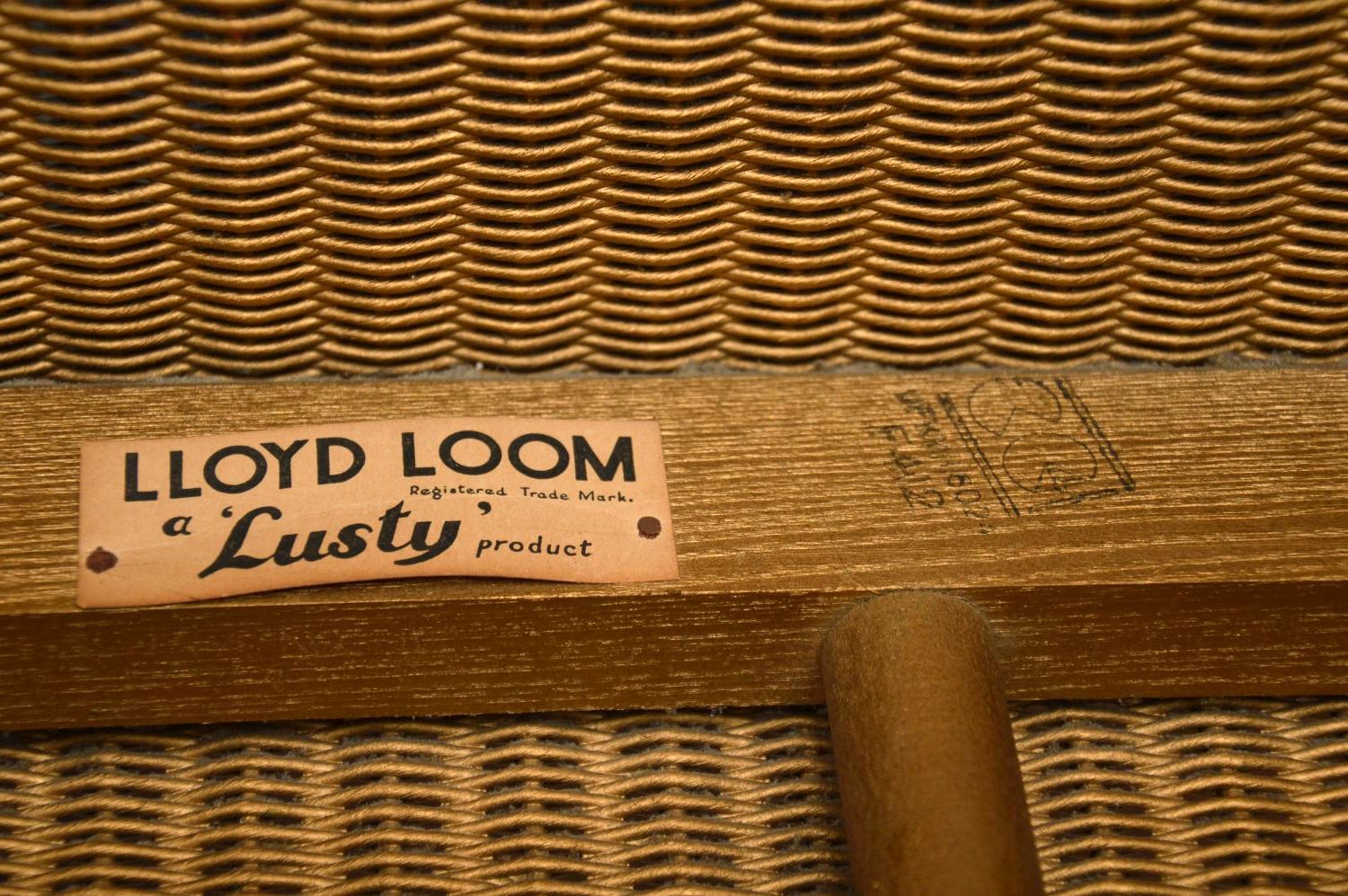
When people admire a Lloyd Loom chair or basket today, running their hand across its smooth woven surface or noting the elegant curves of a laundry basket, most assume they’re looking at a clever piece of British design. In truth, Lloyd Loom began life in the United States in 1917, patented by American inventor Marshall Burns Lloyd. But its rise to fame, its widespread adoption and its transformation into a beloved staple of British homes owes almost everything to a single company: W. Lusty & Sons.
Without Lusty, Lloyd Loom might have remained an obscure American innovation. With them, it became one of the most recognised and enduring furniture styles in Europe. This is the story of how a family-run company from East London took a simple paper-and-wire invention and turned it into a design legacy.
A Clever Invention Meets a Cleverer Company
Marshall Burns Lloyd’s 1917 invention, paper tightly wrapped around wire and woven on a loom, was ingenious, but the American market was not yet primed for it. W. Lusty & Sons, however, immediately recognised its potential. Founded in 1873, Lusty’s had decades of experience producing cane and bentwood furniture. They knew two things better than almost anyone: the limitations of traditional wicker, and the fast changing tastes of British consumers in the early 20th century.
When Lusty’s secured the licence to manufacture Lloyd Loom in the UK in 1921, they saw an opportunity not merely to replicate the American product but to reinvent it. They understood Britain’s rapidly evolving domestic market, smaller homes, a growing middle class, a desire for furniture that felt modern but still looked refined. Lloyd Loom’s strengths, its smooth surface, its uniformity, its ability to take paint beautifully, were exactly what British interiors were asking for.
Lusty’s didn’t just manufacture Lloyd Loom. They perfected it.
From Idea to Industry: The Rise of the Bow Factory
Lusty’s innovation required scale, and in 1928 they acquired a vast former aircraft hangar in Bow, East London. This became the legendary Lloyd Loom Works, a factory so large and so productive that at its peak it employed more than 400 people. Here, thousands of woven panels were produced weekly, painted, assembled and distributed across Britain and the wider Empire.
The Bow factory turned Lloyd Loom into an industry. Lusty’s designed the furniture, trained the workforce, standardised production methods and made Lloyd Loom accessible to ordinary homes rather than just the wealthy. The scale of their operation made them the world leader in Lloyd Loom production, no other company came close.
It was also Lusty’s who introduced many of the designs we still associate with Lloyd Loom today, the elegant bedroom chair with the curved back, the dressing table stool, the ottoman with lid, the capacious laundry basket, and the iconic tub chair. These weren’t American imports. They were British creations shaped by British homes.

Capturing the 1930s Aesthetic
Lusty’s success was partly due to perfect timing. The 1920s and 1930s were decades of design transformation. Art Deco was flourishing, modernism was emerging, and traditional, fussy Victorian furniture was finally being pushed aside. British consumers wanted something clean, modern, light and uplifting.
Lloyd Loom, painted in soft pastels or warm neutrals, fit the moment perfectly.
It was Lusty’s who positioned Lloyd Loom as the furniture of the modern home. Their catalogue photography, advertisements and showroom displays presented the pieces as fresh, hygienic, elegant and sophisticated. In an era when wicker and cane could be rough, inconsistent or prone to fraying, Lloyd Loom offered a silky, uniform surface that felt luxurious without the price tag.
This is why Lloyd Loom furniture found itself in every corner of British life: from ocean liners and top hotels to tea rooms, department stores and suburban conservatories.
Beyond the Home: Lloyd Loom Everywhere
One of the most striking achievements of Lusty’s was their ability to move Lloyd Loom beyond domestic settings. They realised early on that the material’s durability and smoothness made it ideal for high traffic environments. Soon, Lloyd Loom chairs and loungers were appearing in:
theatres, restaurants, cruise ships, hotel lobbies, dressing rooms, railway refreshment areas, garden cafés, and even the terraces of seaside resorts.
The more people encountered Lloyd Loom in public places, the more they wanted it in their homes. This was subtle, effective marketing decades before the concept had a name.
By the mid-1930s, Lusty’s claimed to have produced over 10 million pieces of Lloyd Loom furniture worldwide. Whether that figure was precise or promotional, no one doubted the scale. Lusty’s had turned Lloyd Loom into a global phenomenon.
War, Destruction and Reinvention
Everything changed in 1940 when the Bow factory was devastated by bombing during the Blitz. Production halted, machinery was destroyed and a huge portion of the company’s archive and tooling was lost. Many assumed this would be the end of Lusty’s and the end of Lloyd Loom in Britain.
But Lusty’s refused to give up. After the war, they rebuilt and retooled, gradually returning Lloyd Loom to British shops during the late 1940s and 1950s. Although tastes were shifting, the brand retained a strong affection among consumers, especially for its laundry baskets and bedroom chairs.
This resilience is part of why Lloyd Loom remains a recognisable British brand even today. Lusty’s survival ensured the style endured long enough to become a classic, not a fad.
Why Lusty’s Matters More Than Anyone Else in Lloyd Loom History
If Lloyd invented the material, Lusty invented the culture around it.
Their significance can be summarised simply:
Lloyd Loom became iconic not because of Marshall Burns Lloyd — but because of W. Lusty & Sons, who saw what it could be, made it beautifully, marketed it intelligently and produced it at a scale no other company achieved.
Their designs defined the British interpretation of Lloyd Loom. Their quality set the standard. Their factory in Bow became the global centre of production. And their catalogues, advertisements and showrooms embedded Lloyd Loom into the imagination of an entire generation.
Even today, when collectors talk about “real” Lloyd Loom, they often mean one thing: original Lusty’s pieces.
The Demise of Lusty.
Their involvement eventually came to a gradual and quiet end. The destruction of their vast Bow factory during the Blitz dealt a blow from which the company never fully recovered. Although they rebuilt after the war and continued producing Lloyd Loom furniture into the 1950s and 60s, the post-war shift toward new materials, cheaper imports and changing tastes slowly squeezed them out. By the late twentieth century, production had dwindled and the original company dissolved, leaving behind only its designs, trademarks and a legacy of craftsmanship that modern manufacturers still imitate but can never entirely replicate. Today, when collectors talk about “real” Lloyd Loom, they mean Lusty’s — a reminder that while the furniture survives, the golden era of its British makers is now a chapter in design history.
#LloysLoom #LloydLoomLusty #Lustys #RetroFurniture #RetroBathroom

 The Rights of Fans.