by Chris Harris
This first part looks back at how the old GM Vauxhall Conference saw itself long before anyone talked about “Division Five.” It traces the mindset, the culture and the independence that defined non-league football through the 1980s and 1990s — and how automatic promotion gradually reshaped ambitions, identities and expectations. It’s the story of how the Conference moved from proud outsider to eager challenger.
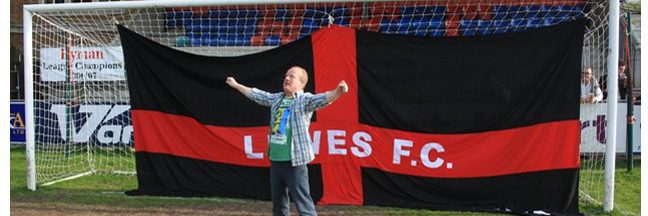
It goes as far back as the mid to late 1980s, when I was regularly going to watch Crystal Palace, that Lewes FC and non-league football first came onto my radar. I’d always had a deep interest in football at every level, but it was around that time that something clicked. As a young man, I’d been asked to source a load of vintage furniture for a quirky new office in Brighton run by a PR firm — the same firm that handled the PR for the GM Vauxhall Conference, as it was then. I can’t remember the bloke’s name now — Scott, maybe? Really nice guy. We even ended up watching a couple of Palace games together.
I remember asking him, quite innocently: “Why don’t the Conference want to join the Football League?” His answer — most of which I’ve forgotten — was basically, “It’s not in their interests. They just don’t want to.” That stuck with me.
I mention it now because I recently saw someone who looked just like him, which sent me down a little rabbit hole of curiosity and research. And that’s what led to this two-part look at how non-league football has shifted from proud independence to becoming, in all but name, the unofficial Division Five of English football.
In the 1980s and early 1990s, the GM Vauxhall Conference, the forerunner of today’s National League stood proudly apart from the Football League. Its identity was built not on being a “fifth division,” but on being the undisputed pinnacle of non-league football. Clubs like Barnet, Enfield, Altrincham, Kettering Town and Wycombe Wanderers competed fiercely in a competition that saw itself as something distinct, something older and in many ways more authentic than the Football League’s lower tiers.
Promotion into the League as still decided by election rather than performance, and many in the Conference hierarchy were reluctant to push for structural change. To them, being “top of the non-league pyramid” wasn’t a consolation prize, it was the glittering prize.
This sense of independence was reinforced by the culture of the time. Many clubs believed that their identity, sustainability and governance would be compromised by membership of the Football League. The Conference leadership was wary of losing control, wary of the financial expectations that League membership carried, and wary of becoming a mere extension of a system that had never fully respected non-league football. The Conference valued its autonomy more than the prestige of being part of the League structure.
Reform, Ambition and the Collapse of the Old Order
The abolition of election to the Football League in 1986, and its replacement with guaranteed promotion for the Conference champions, marked a turning point. Slowly at first, but decisively over time, the incentives changed. Clubs like Wycombe, Yeovil and Kidderminster demonstrated that ambitious, well-run non-league sides could not only step up but thrive. The creation of automatic second promotion spots and, later, the play-offs accelerated this shift.
Badly run league clubs, just drifting, began to get drowned by fit and efficient whipper snappers from the Conference.
At the same time, the Football League itself was changing. The formation of the Premier League in 1992 and the financial stratification of the game forced League Two clubs to operate more like successful non-league sides: leaner, more commercial savvy, and more reliant on community support. The old gap, sporting, financial and infrastructural, narrowed dramatically. By the 2000s, many Conference clubs were wealthier and better supported than the teams they sought to replace.
The National League, especially after its rebrand in 2015 and the introduction of improved broadcasting deals, became less a standalone “top of non-league” identity and more the de facto fifth tier of the pyramid in all but name. The remaining obstacles to formally calling it Division Five were no longer philosophical but political: the Football League was not eager to dilute its brand, and clubs feared the commercial implications of renaming their divisions. By this stage, attitudes within the National League had reversed; ambition, not autonomy, became the defining cultural driver.
The Modern Reality: A Pyramid Without the Labels
Today, the National League functions entirely as Division Five, whatever the official titles may say. It is tied into the EFL promotion-relegation mechanism, financially interconnected through shared broadcasters, and increasingly professionalised from top to bottom. The old mindset of preferring to remain “top of non-league” has largely vanished, replaced by clubs who aspire to full-time professionalism, improved facilities and the revenues that EFL membership brings.
What once held the league back, the Conference’s own reluctance, the Football League’s protectionism, and the cultural pride of being outside the system, has been superseded by the realities of modern football economics and a new efficiency. The vested interests that remain today are no longer in the National League but in the EFL itself, which still resists any rebranding that might appear to downgrade League Two or upset its commercial hierarchy. But culturally, competitively and structurally, the fifth tier is already part of the same ecosystem. The only thing missing is the name.
#National League #Non League Football #EFL #Football Pyramid #Non League Divisions

 The Rights of Fans.