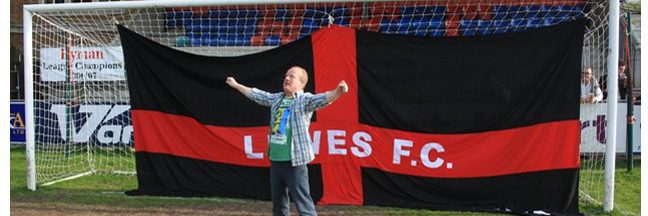
by Chris Harris

New York Times Athletic 12/7/21
“When I talk about our ambitions off the pitch – which are connected to those on the pitch – they are to become the most fan-owned football club in the world.
“At the moment, we have 1,700 owners across 36 countries and we want to turn that into 140,000, the same as Barcelona. Essentially Lewes vs Barca.”
When a Lewes FC director made the following claim in the New York Times’ The Athletic, it landed with a mix of disbelief and quiet embarrassment. Four years on, it’s worth revisiting, because time has a way of stripping grand statements down to their bones.
It has been an ugly trait at Lewes FC to espouse great ideas on a buy now pay later platform, in other words grand ideas, slag off everyone who questions them, as it will take a long time before judgement can be made. Look at the crazy £10 million valuation of the Lewes FC Women a few years ago, eye watering self aggrandizement. Well with that entity about to be potentially at least partially sold to investors I rather suspect the actual sale value will be nil and the price just the investment required to keep it afloat. Zero.
At the moment the bizarre membership claim was made, Lewes FC had around 1,700 members. The ambition, we were told, was to grow that number to 140,000, explicitly invoking Barcelona as the comparator. “Essentially Lewes vs Barca.” This wasn’t framed as a thought experiment or a rhetorical flourish. It was presented as a serious statement of intent, a roadmap for what fan ownership at Lewes FC was supposed to become. It makes the insane £10 million claim look vaguely sane.
To be fair, there was a context in which such an idea might briefly have seemed plausible. At the time, Lewes FC was enjoying an extraordinary level of international media attention off the back of Equality FC. Articles appeared across the global press, particularly in liberal, progressive outlets. There was a sense, among some within the club’s leadership, that Lewes FC might become the football club for women, or at least a massive globally recognised brand synonymous with women’s football and equality. The assumption appears to have been that this attention would translate into mass membership from women worldwide, turning Lewes into something closer to a movement than a football club.
Even then, that belief required an astonishing suspension of reality. Women’s football, despite welcome growth, was and remains a niche sport. Outside of major international tournaments, it does not command mass audiences, global tribalism, or lifelong institutional loyalty. To imagine that a small non-league club in Sussex could leverage that moment into 140,000 committed members was not optimism. It was delusion. Geography, scale, competition for attention, and the simple mechanics of fandom were all ignored.
Reality, unsurprisingly, has been less accommodating. Four years later, membership now sits at roughly 1,600, amazingly lower than when the claim was made. In the intervening period, substantial sums were spent on marketing, branding, campaigns, and positioning. At its peak, membership briefly rose to around 2,700, before falling back again. That spike now looks less like organic growth and more like the temporary effect of hype, novelty, and intense media exposure.
What makes the claim remarkable is not just that it failed, but that it stands in a league of its own. Football is littered with overambitious statements: clubs talking about “sleeping giants,” five-year plans, pathways to the Premier League, Champions League dreams, “Europe within a decade.” Almost all of these collapse under scrutiny. But even by football’s famously inflated standards, Lewes vs Barca is extraordinary. Few clubs have ever publicly suggested scaling their support base by a factor of eighty-five, while operating in the seventh tier, in a town of fewer than twenty thousand people.
Barcelona’s membership was not engineered. It was accumulated over more than a century, embedded in civic identity, political history, geography, and scale. Lewes, by contrast, is small, and that is not a weakness. It is simply a fact. To ignore it was to confuse visibility with substance, attention with commitment, and media narrative with lived reality.
Seen from today’s vantage point, the quote isn’t merely embarrassing. It is instructive. It captures a moment when aspiration tipped into fantasy, and when leadership began governing for an imaginary future rather than the club that actually existed. In doing so, it helps explain why fan ownership at Lewes FC has not been strengthened but hollowed out.
If there is a more outlandish claim in modern football, one so untethered from reality, scale, and history it is hard to think of it.
#Lewes FC #Barcelona FC #Non League Football #Football #Crazy Claims

 The Rights of Fans.