by Chris Harris


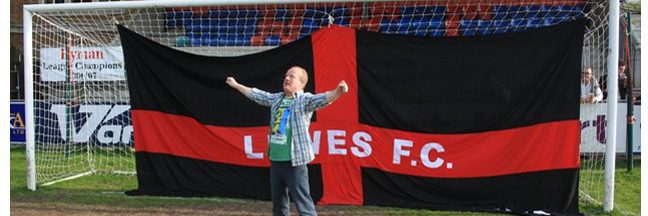
This is part 1 of my blogs on the ‘How Lewes FC Strangled the Life Out of Fan Ownership.’ The links to the four others are below.
Steve King led Lewes FC to promotion to the Conference National (now known as the National League) in the 2007–08 season. Under his management, the club won the Conference South title that year, marking our first and only promotion to the top tier of non-league football. In no time we had been bankrolled from Ryman 3 to the top flight of non league football under the astute financing and ownership of Martin Elliott, a local property developer. For five years, it had been success after success, including the redevelopment of our beautiful ground, The Dripping Pan, thanks entirely to Elliott and dare one say, private financing, often regarded as the best non league stadium in the UK. As the story below unravels, one also has to consider when observing fan ownership, the benefits and pitfalls of private ownership.
King was controversially dismissed shortly after securing promotion, literally the day after. The club’s directors cited concerns over sustainability and the financial demands of competing at a higher level, stating that King had not been instructed to achieve promotion and that his success had created unforeseen challenges for the club. ‘The Manager Sacked For Being Too Successful’ ran the Guardian as a director ridiculously claimed they had never asked him to get the club promoted. Heavily bankrolling him would suggest otherwise. In reality, the financial crash hit, and the bankrolling was removed, and some felt faces needed saving. In reality when everyone pinched themselves at our success, at a club where there was, back then, no self-entitlement or expectation, excuses were not needed when the inevitable going tits up arrives.
The comedy season had begun and continued and continues now turning into 2026.
The club was in financial peril, but Elliott successfully guided it through a tough few years of austerity, keeping us in the old Conference South on a shoestring budget. Despite offers from other private enterprises to take over the club, he eventually ceded control to fan ownership rather than irresponsibly taking the easiest option for a quick buck. Martin Elliott was the club’s greatest owner. The boards of Lewes FC under fan ownership have repeatedly disgraced themselves, claiming we were twenty-four hours from going bust, but the process of Eliott disposing of the club was measured, and there was no risk of bankruptcy. The headline claims of the board, ‘we were 24 hours form being wound up in the High Court’ is bullshit, it is business practice and brinkmanship when in tight situations to conduct proceedings in this manner, especially when Elliott had genuine interest from other parties he felt ‘were not the right fit’ Going bust, yeah right!
During this interim period, some of us had set up the Lewes FC Supporters Trust. I was on the original steering committee. I left and started the club fanzine, still going strong nearly 20 years later. My partner at the time was the treasurer, so I helped out still. Frankly, had the club gone bust and inevitably been forced down the leagues to county football, the original Supporters Trust could have run the club fine at a lower level.
Not long after the official launch of the Supporters Trust, touchingly attended by Martin Elliott, a buzz went around the town as a new takeover was announced by a fan group who the original Supporters Trust ceded control of the fan ownership model, constitution and essentially the Supporters Trust to. It was on the face of it, a group of rank amateurs handing over to some credible professionals.
A group called Rooks125 facilitated this transformation, named in honour of the club’s 125th anniversary and symbolising a new beginning rooted in shared ownership.
The initial composition of the Rooks125 group immediately raised red flags. It included two highly successful businessmen in finance and marketing, the head writer of the Horrible Histories TV series, Oscar-nominated Patrick Marber, and others from media backgrounds. They were undoubtedly talented, but crucially, none had experience in football, hospitality, or event management. From the outset, the leadership lacked any practical grounding in the areas where our club needed patching up and where fan ownership and involvement could thrive.
What was surprising was the chairperson of the original Supporters Trust Councillor Ruth O’Keefe, recognised at the time as the most influential woman in Lewes, and Steve Watts, who she preceded and who had just single-handedly put on a small fundraising festival, were completely left out of the picture. Boards of fan-owned clubs are allowed to co-opt unelected directors, but when they set up Rooks125 with a questionable mix of new faces, why were hardcore Lewes FC and Lewes people ignored?
As time evolved, what became apparent was that this was less of an oversight and more a new board determined to do it their way and not necessarily the fan-owned way. Ruth O’Keefe was a firebrand, and it would be arrant nonsense to challenge a mode of thinking that fan ownership would not have thrived with her involved.
The rules laid out in the Lewes Community Football Club constitution couldn’t be easier to understand. The club’s objects are to act as responsible custodians for future generations, operating democratically, fairly, and transparently, while ensuring financial responsibility in the community’s long term interests. Written within the constitution is basically a brilliant and simple guide to creating a model fan owned club, if the rules and spirit are followed correctly. In these articles about Lewes Football Club you will read very little about the virtues necessary for successful fan ownership!
It was an exciting time. Fan ownership was a perfect fit for Lewes.
Lewes, uniquely, is a town built for community ownership. It’s Bonfire societies, some dating back to the mid-19th century, organise the largest Bonfire celebration in Britain, once drawing crowds of 80,000. A perfect blueprint to lean into for fan ownership. Entirely volunteer run, it’s a civic masterpiece and triumph of local entrepreneurship, community engagement, and self-sufficiency. All Lewes FC had to do was tap into this perfect blueprint and resource for proven success.
However, as the new ownership model unravelled it soon became clear that things were not panning out as hoped.
Far from reaching out to embrace the extraordinary human and financial resources right on its doorstep, Lewes FC turned inward. Lewes is a wealthy, highly skilled town, but instead of genuine invitations to roll up our sleeves and help build the brilliant community club we all believed in with the board, we got soundbites and marketing claptrap. Hollow slogans like “we like to do things differently” and the quest for “smart ideas” rather than ownership involvement, came to define the club’s direction, superficial branding that replaced the real values and spirit of community ownership the club was founded on.
It’s fair to divide the fan-owned era of Lewes FC into two distinct phases: 2010–2017 and 2017–2025, for reasons that will soon become clear. Parts 2 and 3 will be a look at those two eras.
#Lewes FC #Fan Ownership #Football Governance #Gross Mismanagement #Narcissism

 The Rights of Fans.