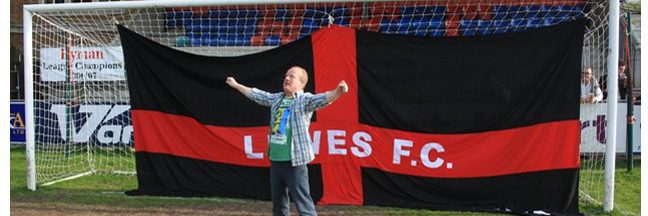

This is part 5 of my blogs on the ‘How Lewes FC Strangled the Life Out of Fan Ownership.’ The links to the four others are below.
by Chris Harris

A conclusion and then we ask the question, can it ever work?
Out of a club drifting in the fog of decline, something unexpected briefly appeared: competence and a ray of hope.
While the club’s senior leadership continued to wander aimlessly, clinging to tired quick-fix solutions, abstract thinking and the same exhausted narratives, the Lewes FC Football Foundation quietly got on with the job. A group of dedicated volunteers ran the youth teams, veterans’ sides, community football programmes and the 3G pitch selflessly, with efficiency, discipline and purpose. They focused on the parts of the club they could actually influence and, in doing so, became the true operational soul of Lewes FC.
For the first time in over a decade, there was something at the club that felt rooted, relevant and real. A steely sense of stewardship. A seriousness of purpose. The kind of grounded competence fan ownership is supposed to produce but so rarely does in practice. It was football administration stripped of ego, politics and performance, and it worked and still is,
Then, in the 2025 board elections, something genuinely remarkable happened. Redemption?
Out of nowhere, five candidates affiliated with the Foundation stood for election. Fifteen people in total were competing for five board seats. The contrast between the two camps could not have been clearer, nor more instructive.
On one side were what I described in the fanzine as the “internationalists”: members with little or no connection to Lewes, some who had never attended a match, yet who remained keen to continue pushing social and ideological agendas the club no longer had the capacity, finances or organisational strength to sustain. On the other were the “homegrowners”: local people, deeply embedded in the town, committed to restoring Lewes FC to its roots as a football club serving its community and respecting the traditions of non-league football.
For the first time in years, the election actually mattered. It became tense, argumentative, even fractious, which is exactly how you know something meaningful is at stake. Democracy, when real, is rarely comfortable.
Despite being a supposedly democratic club meant to represent the local community, the leadership’s messaging was unmistakably tilted towards the internationalist candidates. There were whispers of underhand persuasion and backroom manoeuvring, all designed to steer the election in a particular direction. One incident, however, stood out as emblematic of how far removed the board had become from the lived reality of football clubs.
The five Foundation-backed candidates asked for permission to distribute leaflets at a home match ahead of the vote, entirely standard practice in any democratic organisation. The leadership discouraged them from doing so, arguing that it would be “unfair” to international members who could not attend. This reasoning was not merely weak; it was extraordinary. A football club actively discouraging campaigning at a football match, in deference to people who do not go to football, is not democracy. It is institutional confusion bordering on farce.
Despite this interference, four of the five available board seats were won by local, Foundation-aligned candidates. The board couldn’t even do that properly.
For the first time in fifteen years of fan ownership, the board was split. Half of it now appeared genuinely committed to running Lewes FC as it was always supposed to be run: for the people of Lewes and for those who actually love non-league football. In that sense, we had come full circle. The board now resembled, uncannily, the original 50/50 split of fifteen years earlier, half serious about fan ownership, half fundamentally misunderstanding it.
On May 1st, 2025, Jim Cheek, Miranda Kemp, Pete Bull and Roger Warner were elected on a platform of renewal. They could have proved to be the most pivotal directors in the club’s fan-ownership era. But they were also inheriting a football club in severe financial distress.
Even sweeping reform might already be too late. The fear, grounded in long experience, was that they would go the way of so many well-intentioned directors before them: swallowed whole by the day-to-day grind of survival. Ideals eroded by exhaustion. Promises softened by necessity. Conviction gradually replaced by compromise simply to keep the lights on.
And yet, briefly, there was reason to believe something different might happen.
If these directors remained true to the commitments set out in their manifestos, volunteers would rally. People would step forward to do the unglamorous but vital work of governance. That, in turn, might free the board to focus on strategy, fundraising and repairing the club’s shattered finances.
That fresh hope received a shot in the arm as something important happened.
A full-page spread appeared in the local paper. The Dripping Pan on the front page. A public appeal. A £120,000 black hole in the close season. I had issues with how the plea was framed, but this was something I had argued for years: honesty. Saying out loud, without spin or euphemism, “We’re skint, please help.”
Shortly afterwards, Miranda Kemp appeared on local radio, appealing for help and involvement. Slowly, very slowly, maybe people and organisations were beginning to feel their way back towards their hometown football club. For a moment, it felt as though redemption might be possible.
And then it fell apart. Again.
No sooner had the new directors settled in than the familiar Lewes FC pattern reasserted itself. Straight-line thinking. Our way or no way. The gravitational pull of the old culture proving stronger than the reforming impulse. New arrivals quietly falling into line.
Financial transparency followed the same depressing trajectory. It began with honesty, an admission of serious trouble, and then morphed, within months, into the old deflection: ‘this happens to all football clubs at this time of year’. It doesn’t. It never has at Lewes FC. And with that, misrepresentation crept back in. Half-truths replaced clarity.
Then came the truly astonishing move.
In the name of making the club more “attractive to investors”, the board put forward a proposal allowing external investors a say in how the club is run. However it is framed, the reality is unavoidable: this marked the end of pure fan ownership at Lewes FC.
The turnout was dreadful. That fact alone speaks volumes about how hollow the idea of fan ownership had already become. Those who did vote were apparently content to jettison it entirely. As ever, this was presented as progress.
But if you are a fan-owned club, and you vote to give up fan ownership while insisting it is a step forward, then someone really does need to explain the logic. From where I am standing, that was the moment it ended. Officially.
In fairness, three ‘progressives’ have subsequently resigned, got a whiff of the serial incompetence on the board and walked.
The club will limp on, still trading on the language and branding of fan ownership, but the numbers do not lie. Membership has fallen from around 2,600 to 1,600 in the space of just a couple of years. That is not coincidence. It is the predictable outcome of telling people they own something, and then repeatedly demonstrating that they do not.
This did not fail because the fan-ownership model was wrong.
It failed because those entrusted to run it never truly believed in taking the community with them. Governance became a revolving door of directors with little connection to the club, the town or non-league football. Oversight bodies proved useless. The Football Supporters’ Association offered indifference when serious concerns were raised years ago. Government cheer-led the concept while refusing to provide the regulatory framework required to make it work.
Fan ownership became branding, not practice.
Yes, supporters also bear some responsibility. Thousands signed up, then disengaged entirely. Elections were decided by handfuls of votes. From that wafer-thin democratic mandate came sweeping decisions that dismantled the model altogether.
And yet, the volunteers, the town, the people who genuinely care — they remain extraordinary.
Fan ownership did not fail because Lewes is incapable of it. It failed because successive directors treated it as a lifestyle project, a platform, or a badge,not a duty.
Goodwill always runs out. Without rigour, humility and accountability, ideals rot under pressure.
Lewes FC did not need saving by ideas.
It needed people willing to do the work.
That chance came.
And once again, it slipped away.
Can Fan Ownership Ever Work at Lewes FC?
I no longer believe that fan ownership can work at Lewes Football Club. As such, I am happy to see it jettisoned for private ownership and a dose of honesty. The man who brought massive success to Lewes FC after all, Martin Elliott, would always happily talk straight in the pub about what his agenda was, the irony being that, under fifteen years, that sort of transparency has never materialised.
Fifteen years is not an experiment cut short. It is not bad luck. It is not teething problems. It is a full cycle. And what that cycle has demonstrated, repeatedly, is that fan ownership at Lewes has not empowered supporters in any meaningful or democratic sense. Instead, it has attracted a very particular type of person: those who believe fan ownership is a mechanism through which they get to define the club in their own image, rather than a discipline designed to protect a football club from precisely that kind of capture.
Time and again, fan ownership at Lewes has been treated not as a system with rules, constraints and responsibilities, but as something malleable — something to be “reimagined”, “modernised”, or quietly bent to suit whoever happens to be in charge at the time. That is not how fan ownership works. Or rather, it is exactly how it fails.
The contrast with FC United of Manchester is instructive, and unavoidable. FC United are not perfect, but they are rigorous. They stick to their constitution. They adhere, often uncomfortably, to the principles of supporter control, democratic accountability, and community anchoring. They do not reinvent fan ownership to suit fashions or personal politics. They submit to it. And because of that, it works.
That is not a coincidence.
Fan-owned clubs operate under different constitutional models. Some are tight, prescriptive, and deliberately restrictive. Others are loose, opaque, and easily manipulated. Lewes FC falls firmly into the latter category. Its constitution has proven flexible enough to be interpreted, stretched, and repurposed by successive boards — often in ways that directly undermine the very idea of fan ownership itself.
Those systems exist for a reason. They are not bureaucratic obstacles. They are safeguards, built from hard experience, designed to prevent capture by ego, ideology, or convenience. Ignore them, and the model collapses. Every time.
What Lewes FC has practiced instead is a version of fan ownership that resonates very neatly with the liberal elite who have dominated the club for years. It looks good. It sounds good. It travels well. It flatters self-image and reassures sponsors. But in practice, it functions primarily as a branding tool — something to be referenced in press releases and funding pitches, rather than a lived reality.
New people may well come and go, periodically “rediscovering” fan ownership, repackaging it, and rolling it out once again as proof of moral seriousness. But unless the underlying structure changes, nothing else will. It will remain phoney — fan ownership in name, not in substance.
There is, in theory, a way out.
It is entirely possible, legally and practically, for an alternative supporters’ trust to be established at Lewes, independent of the FSA, with a constitution modelled on FC United of Manchester. A constitution that is explicit, restrictive, and uncompromising about democratic control, term limits, transparency, and local accountability. A constitution that does not allow itself to be endlessly reinterpreted by bad actors.
Were such a body ever to exist, I suspect many people in Lewes would rally behind it. The town has not lost its capacity for collective action. It has lost its patience.
But that, realistically, is for another day. Because the deeper truth is this: I don’t think anyone can be bothered anymore. I don’t think people care. Not because the idea of fan ownership is wrong, but because Lewes FC has drained it of meaning. What was once inspiring now provokes little more than a shrug. The concept has been talked to death, rebranded to exhaustion, and hollowed out through misuse.
Fan ownership at Lewes FC is not wounded. It is not fragile. It is not in need of reform.
It is finished.
What will remain is the language. The moniker. The phrase “fan-owned club” will continue to be tediously rolled out in statements and media coverage, long after it has ceased to describe anything real. A label without substance. A story without truth.
That, in the end, is the bleakest conclusion of all. Not that fan ownership failed — but that it was allowed to be reduced to something so empty that nobody even argues about it anymore.
And that is where this story truly ends.
#Lewes FC #Fan Ownership #Football Governance #Gross Mismanagement #Narcissism

 The Rights of Fans.