by Chris Harris

One of the things I find endlessly fascinating about vintage objects is their life cycle, why some things survive for hundreds of years, while others fall out of favour, get altered, discarded, or written off entirely and thrown away. It often has very little to do with quality, and everything to do with fashion.
Take Victorian pine furniture. In its day, pine was considered cheap and downmarket, which is why it was almost always painted. Fast forward to the 1980s and 1990s, and all that paint was stripped off in the pursuit of “honest” bare wood. The very thing that once made it undesirable became its selling point. Taste changes. Context changes. Objects don’t, but how we see them does.
Which brings me to a very sad-looking old Singer sewing machine base I recently found at a market.
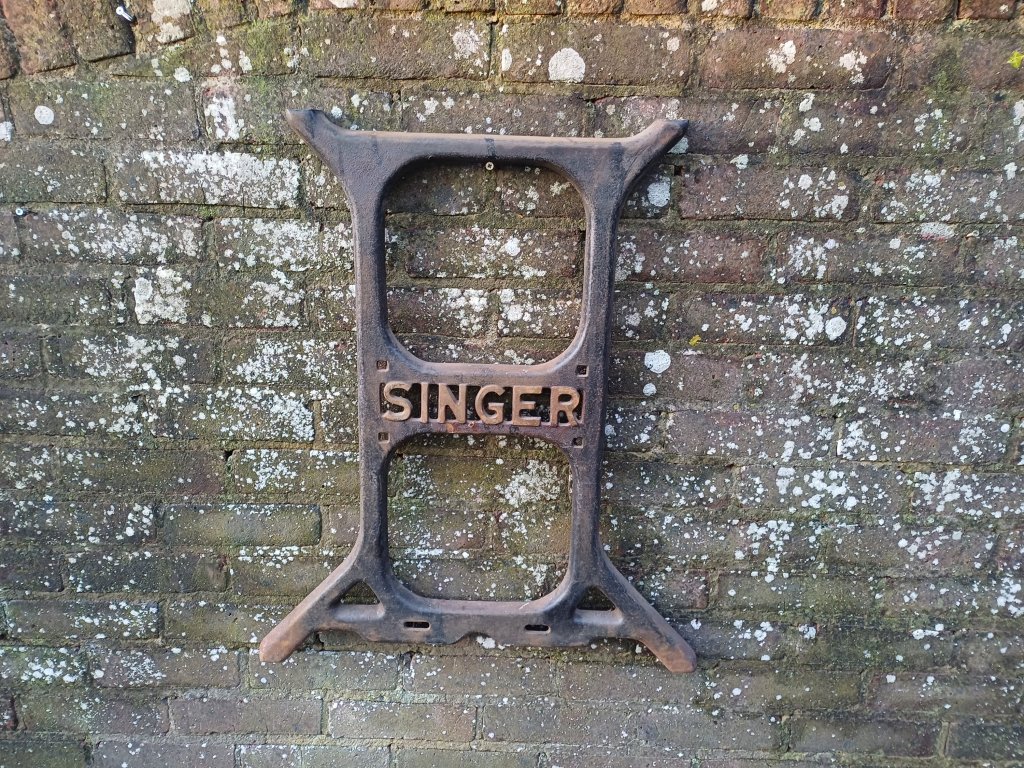
These freestanding iron sewing machines were routinely destroyed for years. Nobody wanted them. They were seen as creepy, bulky relics with no practical use. Many of the Victorian and late Victorian examples had the sewing machines removed, wooden tops added and were reborn as side tables, some of which look fantastic. But even then, they were never wildly commercial.
This one was worse. Incomplete. Awkward. Maybe more mid-20th century. The sort of thing most people would assume had nothing going for it beyond scrap value. You could almost see its future narrowing towards landfill.
But when I actually looked at it properly, what stood out wasn’t what was missing, it was what remained.
Three separate pieces emerged as genuinely saleable objects in their own right: the two side panels bearing the Singer name, and the pedal base with its bold industrial branding. Clean them up, lightly wire-brush them, give them a polish, and what you’re left with are three architecturally beautiful fragments of our industrial past. The photos are pre-wired wool and polished!

And this is the bit people forget about Singer…
Singer wasn’t just a sewing machine company. It was a global symbol. It represented modernity, domestic progress, ambition, independence. These weren’t just tools, they were status. They sat in homes like quiet monuments to “we’re doing alright now.”
There’s something oddly moving about that, actually. The Singer name isn’t just branding, it’s history stamped in iron. It’s the echo of hundreds of thousands of lives: women making clothes, repairing, surviving, creating, earning, and making do. All that invisible labour embedded into something as heavy and permanent as cast metal.
Advertising and product-related pieces from this era are highly collectible. They tell a story. Mounted on a wall, these Singer elements stop being redundant machinery and become sculptural, graphic, and incredibly contemporary. Sold separately, as they will be, because they’ll inevitably end up in different homes, they’re not only aesthetically strong and very on-trend, but also genuine talking points.
Let’s be honest, it really is trendy right now, this idea of pulling old motifs and emblems out of their original context and letting them live as design.
We’re living in an age of clean lines, neutral walls, “curated minimalism”… and yet people are desperate for texture and character. Something with weight. Something that looks like it’s survived a hundred years because it has. Those old industrial emblems, the raised lettering, the decorative flourishes, the confidence of branding, they have a presence that modern décor just can’t fake, the endless stream of dire Far East imported tat with advertising motifs.
Let’s face it, it’s far more interesting than yet another generic abstract print someone bought in a rush because the colours “match the sofa.”
Had I not bought this piece from a clearance seller, I’ve no doubt it would have ended up in landfill. Instead, it’s been reimagined. I’ll make good money from it, yes—but more importantly, three people who love industrial heritage or historic advertising will now live with and enjoy these objects for years to come.
There’s a lesson in that. Before writing something off as hopeless or redundant, it’s worth asking a simple question: what else could this be? Often, the answer is far more interesting than the original use ever was.
#Singer Sewing Machine #Industrial Heritage #Upcycling #Vintage Iron #Vintage Ideas

 The Rights of Fans.