by Chris Harris
Old gold furniture and picture frames often carry a certain grandeur, but they do not always suit modern interiors. Tastes change. Rooms become lighter and simpler. Heavy gilt and gold finishes that once felt rich and impressive can begin to feel dark, ornate or out of place. Painting them in white or another neutral shade is a common way to upcycle and refresh a piece, soften its presence and make it work in a contemporary setting. Upcycling in this way also feels practical and sustainable. Rather than discarding a solid, well made item, people choose to adapt it to their current style and delve into YouTube DIY videos.
However, what these videos do not tell you, is anyone who has painted over old gold finishes will know that the transformation does not always go exactly to plan. What starts as a clean white can slowly shift. Within days or weeks, the surface may develop a faint grey cast. Sometimes there is a whisper of blue or green coming through. It can be subtle or more noticeable, but it is a common experience.
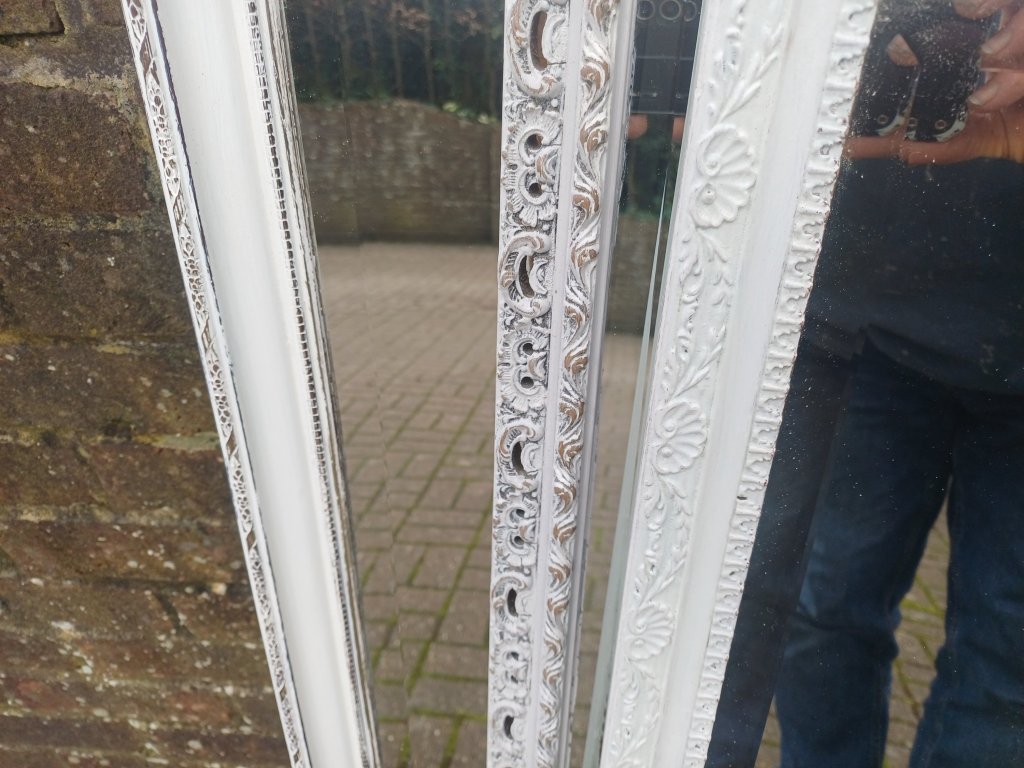
Look at the images, I painted three mirrors, two were wooden and the third gold, you can see just within a few days the colour of the gold one gas turned greyish.
The reason lies in what that gold surface actually is. Much “gold” furniture is not solid gold leaf in the pure sense. It is often a combination of metallic powders, bronze-based paints, shellac, varnish, oil gilding size or coloured glazes applied over a red or dark base. Over decades these layers oxidise. Metals such as copper, which is frequently present in gold-toned finishes, react with air and moisture, hence the bronze colour old copper turns into. That reaction can produce, on gold, greenish or bluish compounds. When you apply a new water-based paint over the top, you reintroduce moisture to a surface that may not have seen it for years. This can reactivate old residues and draw them upward.
Bleed through is the technical term. Stains migrate from the lower layers into the fresh paint film. White paint shows this most clearly because it has very little pigment strength to mask what is underneath. Even if the original gold looks stable, microscopic particles and old varnishes can leach into the new coating. If the piece was previously waxed or polished, those materials can also interfere with adhesion and colour stability. The result is a shift in tone that was never on the colour chart.
Preparation makes a difference. Cleaning thoroughly, lightly sanding, and using a proper stain blocking primer can reduce the risk. Oil based or shellac based primers are particularly effective at sealing in metallic residues before a water based topcoat is applied. Even so, old furniture has a habit of asserting itself. Its previous life is layered into the surface, and sometimes that history seeps back through despite your best efforts.
It is worth remembering that this discolouration is not a failure in the grand scheme of things. Furniture that has survived decades or even centuries has absorbed light, smoke, polish, heat and handling. When you paint over it, you are not starting with a blank canvas. You are adding a new chapter to an existing story. A faint grey or green undertone in what was meant to be pure white is simply evidence of that story.
For many people, the aim of upcycling is not perfection but renewal. A piece that was once too formal or too ornate can become lighter and more usable. If the colour shifts slightly, it rarely undermines the function or the overall look. In fact, it can soften the finish and give it depth. At the end of the day, a little discolouration is just part of the character of old furniture. It is a reminder that the piece has lived before and will go on living in a different form, frigging around with blocks and chemicals as per instructions on YouTube videos should just be ignored, let the old gold shift the colour to where it is intended.
#Vintage Tips #Vintage Blog #Antiques Blog #Old Gold Frames #Old Gold Furniture

 The Rights of Fans.