by Chris Harris

Sweet Fanny Adams: The Curious and Tragic Origins of a Familiar British Phrase
If someone offers you or asks you for something and you reply, “You’ll get Sweet Fanny Adams,” or FA, of course, everyone understands what you mean.
It is one of those phrases that sits comfortably in everyday British conversation. Slightly cheeky, faintly old fashioned, and often shortened to “Sweet FA,” it has become part of the rhythm of the language. Yet very few people realise that behind the phrase lies a story rooted in Victorian England and a tragedy that once shocked the entire country.
The Victorian origins of the phrase
The phrase originates from a real person named Fanny Adams, an eight year old girl who lived in the town of Alton in Hampshire. In August 1867 she disappeared while playing with friends in a nearby field.
Her body was later discovered and the crime horrified Victorian Britain. The murderer, a solicitor’s clerk named Frederick Baker, was arrested, tried and executed later that year. The case received enormous attention in newspapers across the country, which reported the details in a sensational style that was common in the nineteenth century.
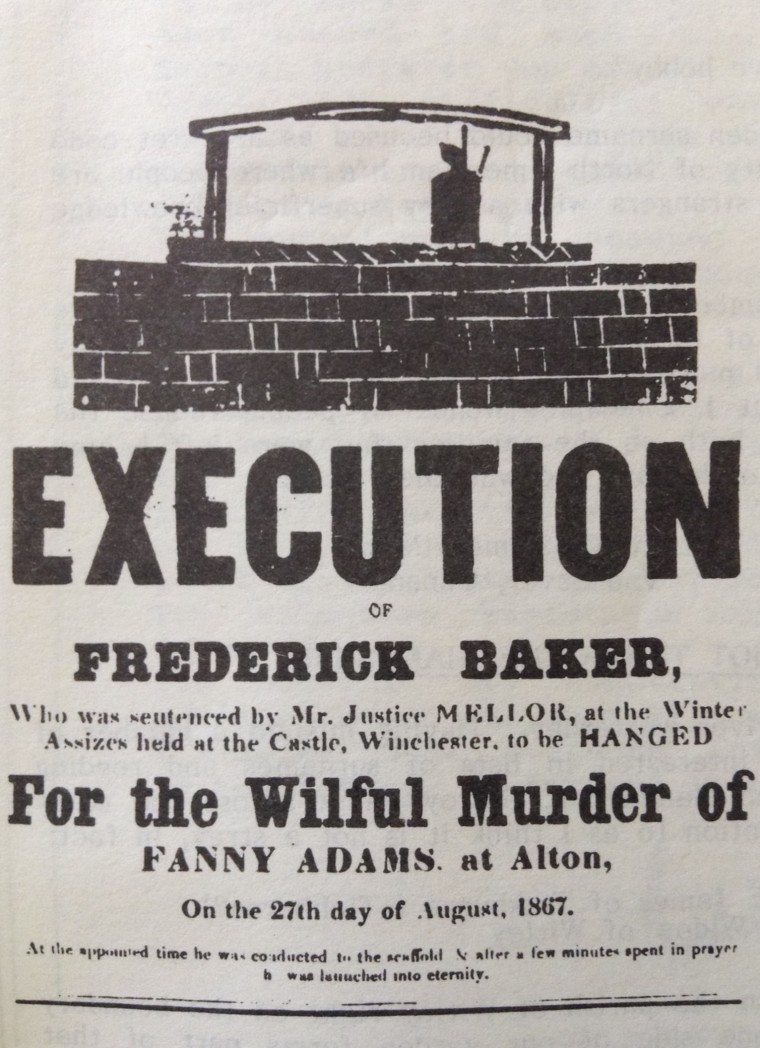
Because of the widespread reporting, the name Fanny Adams became known far beyond Hampshire. For a period the case was discussed throughout Britain, and the name entered the public consciousness in a way that would later influence the language itself.
How sailors turned tragedy into slang
Only a short time after the murder, the Royal Navy introduced a new food ration of tinned mutton for sailors. The contents were chopped meat sealed in tins and it quickly developed a terrible reputation among crews who disliked both the taste and the appearance.
In the dark humour that often develops in close communities, sailors began joking that the unpleasant contents of the tins must be “Fanny Adams.” The reference was grim but it reflected how widely the case had been reported at the time.
Before long the nickname had expanded to “Sweet Fanny Adams,” and sailors used the phrase when referring sarcastically to the contents of the food tins. Over time the expression shifted in meaning. Instead of referring to the ration itself, it began to suggest that the tin contained very little worth eating.
Gradually the phrase came to mean nothing of value and eventually simply nothing at all.
Why the phrase survived
By the early twentieth century the expression had spread beyond naval slang into everyday British speech. It became a humorous way of saying that something had produced no result or that someone was going to receive nothing.
The phrase was later shortened to “Sweet FA,” which helped it survive even longer. The initials also allowed for a cheeky interpretation that people found amusing, even if they no longer knew the original story behind the words.
Today the phrase appears in casual conversation, journalism, football banter and British comedy. Most people who use it have no idea that it originated in a Victorian murder case and a disliked naval food ration.
Language often carries small pieces of forgotten history. “Sweet Fanny Adams” is a good example of how a tragic event, naval humour and everyday speech combined to produce a phrase that still quietly lives on in the English language today.
#Sweet FA #British Phrases #British Idioms #Sweet Fanny Adams

 The Rights of Fans.